
I. Background of the Initiative and Industry Pain Points
With the continuous advancement of industrial automation and factory digital transformation, barcode and QR code recognition have become the most fundamental data collection methods for scenarios such as production traceability, warehouse management, equipment maintenance, and retail checkout. However, most current barcode scanning solutions rely on imported analog chips and interface components, which not only incur high BOM costs and pose supply chain risks but also suffer from common issues like insufficient signal accuracy, poor power stability, and limited interface compatibility. In industrial settings, these limitations often lead to malfunctions such as false triggering, uneven illumination, blurry imaging, and communication interruptions. Particularly for small and medium-sized equipment manufacturers, the processes of signal chain debugging, power optimization, and interface adaptation typically involve lengthy R&D cycles and high verification costs, making it difficult for them to rapidly meet market demands.

To address these challenges, ChisynV has introduced a comprehensive industrial-grade barcode/QR code scanner solution built on a full range of domestically produced analog and interface chips. The solution covers all product types, including handheld scanners and fixed readers, delivering high precision, reliability, low power consumption, and full interface compatibility. It also achieves domestic substitution of core components, enabling customers to rapidly scale up production while reducing costs and improving efficiency.
II. Overall Framework of the Plan
This solution is specifically designed for industrial-grade portable/fixed QR code scanning devices, featuring a full-chain modular design that encompasses four core functional modules:
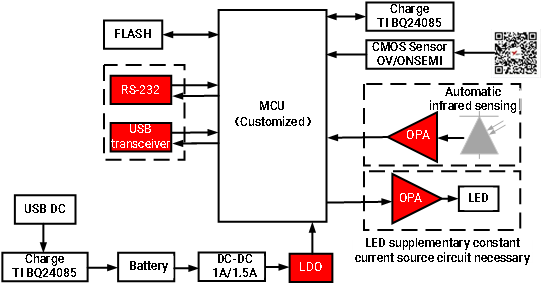
1. Power Management Module: USB charging + lithium battery power supply + DC-DC + LDO multi-stage voltage regulation, delivering a clean and stable power supply;
2. Signal acquisition module: infrared sensing triggering + CMOS image acquisition + high-precision operational amplifier signal amplification;
3. Main control processing module: MCU performs decoding control and uses operational amplifiers for LED constant-current supplementary lighting, ensuring scanning accuracy and speed.
4. Communication output module: supports USB high-speed transmission and RS-232 industrial interface, compatible with devices across all scenarios.
III. Selection of Core Components
The core components of the solution utilize ChisynV's self-developed industrial-grade chips, covering critical categories such as operational amplifiers, voltage regulators, RS-232 transceivers, and USB controller chips. These components precisely meet the industrial-grade requirements of barcode scanning devices, achieving full domestic production coverage across the three key systems: signal processing, power supply, and communication.
1. Operational Amplifier (the core of the signal chain, determining scan accuracy): Responsible for amplifying weak infrared signals, driving LEDs with constant current, and conditioning image signals.
For signal acquisition and conditioning, the solution offers a tiered selection of operational amplifiers, catering to diverse product positioning requirements—from high-end and mid-range to budget models.
1) CD8552 High-Precision Zero-Drift Operational Amplifier
l Function of the device: Infrared sensing for high-precision amplification, and LED constant-current precise control
l Key parameters: Offset voltage 1μV, temperature drift 0.005μV/°C, gain bandwidth 5MHz, rail-to-rail input/output, operating temperature range-40~125°C, low noise level 0.75μVp-p
l Solution Value: The zero-drift design ensures precise triggering across the entire temperature range and stable supplementary lighting, with no signal drift in extreme industrial environments.
2) CD8539 Low-power Zero-Drift Operational Amplifier
l Function of the solution: Signal amplification and low-power supplementary lighting drive for battery-powered devices
l Key parameters: Offset voltage 1μV, static current 360μA, operating temperature-40~125°C, rail-to-rail input/output
l Solution Value: Ultra-low power consumption extends the battery life of handheld devices, while automatic zero-adjustment technology eliminates the need for prolonged calibration.
3) CDLM358 Universal, Economical Operational Amplifier
l Function of the scheme: Basic signal conditioning, LED supplementary lighting drive
l Key parameters: Single power supply range 3–24V, static current 250μA, compatible with standard LM358 pins
l Solution Value: Optimal cost-performance ratio, directly replacing imported models without board modification for rapid deployment.
2. CD1117 Industrial-grade LDO regulator (power supply core, cornerstone of system stability)
l Function: Provides low-ripple, high-stability power supply for MCUs, CMOS sensors, and operational amplifiers.
l Key parameters: Output current 0.8A, load adjustment rate 0.4%, operating temperature range-40°C to 125°C, input voltage 15V, built-in current limiting and overheat protection
l Solution Value: The pure power supply suppresses switching noise and eliminates imaging noise. Features: Wide temperature range and dual protection design ensure long-term stability and uninterrupted power supply in industrial environments.
3. CD3232 RS-232 transceiver (essential for industrial interfaces)
l Function: Enables TTL-to-RS-232 level conversion for interfacing with industrial PLCs, industrial PCs, and legacy terminals.
l Key parameters: ESD protection of ±15 kV air discharge/±8 kV contact discharge; ultra-low power supply current as low as 2.5 mA; transmission rate of 120 Kbps; operating temperature range of-40°C to 85°C.
l Solution Value: Built-in charge pump provides ±15 kV (air discharge) and ±8 kV (contact discharge) ESD protection, eliminating the need for external protection circuits; low power consumption suitable for handheld devices.
4. CD9002A USB Master Control Chip
l Function: High-efficiency USB data transmission – USB communication interface chip
l Key specifications: Enhanced 8051 core, USB 2.0 high-speed (480 Mbps), maximum transfer rate of 50 MB/s, operating temperature range-40°C to 105°C
l Solution Value: High-speed decoding + second-level transmission, optimized for pipeline-based high-speed scanning; industrial-grade wide-temperature performance ensures stable connectivity without code loss.
IV. Typical Application Scenarios
1. Industrial production traceability: fixed-line barcode readers, product barcode acquisition, and MES system data entry;
2. Warehouse Logistics Management: Handheld barcode scanners, AGV vehicle-mounted readers, and barcode scanning for warehouse inbound and outbound operations;
3. Supermarket and retail checkout systems: POS machine scanning terminals, self-service checkout equipment;
4. Device identity recognition: barcode reading for industrial equipment and instruments, and operation and maintenance traceability.